When a Skill Finally Sinks
Movement skills aren’t built by forcing repetition, but by layering quality practice with time and rest.
Date
Jan 16, 2026
Service
BB | Build Baseline
Overview
This piece explores how fundamentals become unconscious and why letting a skill settle is just as important as training it.
Movement skills don’t stick because you try harder they stick because you repeat them long enough to sink.
But repetition alone isn’t enough. It has to be good repetition. Or at least the best quality you can manage at the time. Otherwise, what sinks isn’t the skill you want… it’s the habit you’ll have to undo later.
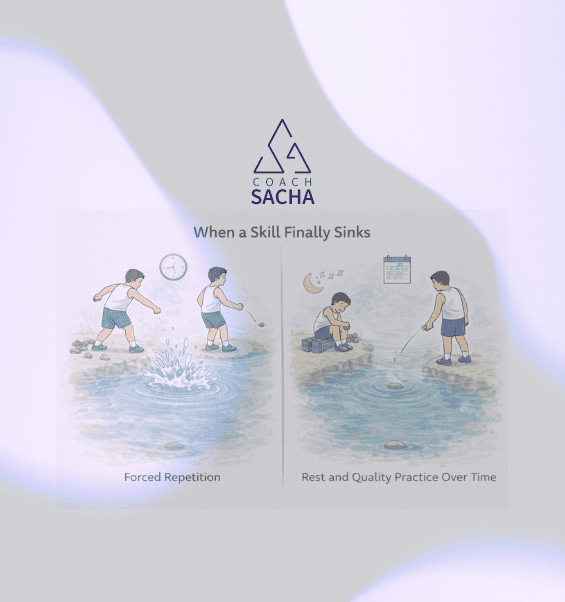
I’ve always had this metaphor that learning a skill is like throwing a rock into a pond.
At first, the water goes everywhere. Splashes, ripples, noise. You’re thinking about every part of it, where your body is, what comes first, what comes next. That’s conscious effort. That’s learning in real time. This is the cognitive stage: we need to think, pay attention, and put effort into every detail.
You throw the rock again. And again. Each time a little cleaner, a little heavier. The ripples get smaller. The movement starts to feel familiar. Less thinking, more doing. This is the associative phase — when sensations start matching actions, and you can relate what you feel to what you’re doing.
Eventually, if the rock is the right one, it sinks.
When it reaches the bottom, the water is calm. You’re not thinking about the movement anymore it just shows up when you need it. That’s the base. That’s when a skill becomes something you have, not something you’re trying to remember. This is the autonomous phase: after enough trial and error, the movement runs quietly in the background.
Here’s the part we often miss.
Research in motor learning shows that a big part of this “sinking” doesn’t happen while you’re practicing, it happens in the breaks between attempts. When you pause, switch tasks, or step away, the brain keeps working. It consolidates what you’ve just done, strengthening the neural pathways without extra effort. In some studies, skills improve more during rest than during the actual repetitions.
That’s why endless reps without pause can backfire. Too much noise, too much force, and the water never clears. On the other hand, rushing poor-quality reps early means you spend years fishing out habits that never should’ve sunk in the first place.
Sometimes the smartest thing you can do is throw the rock…
and then step back and let it settle.
That’s where BB lives. Choosing the right rock. Throwing it with care. And having the patience to let it sink before you start throwing the next one.
Further reading (motor learning & consolidation):
Fitts, P. M., & Posner, M. I. (1967). Human Performance. Belmont, CA: Brooks/Cole.
Walker, M. P., Brakefield, T., Hobson, J. A., & Stickgold, R. (2003). Dissociable stages of human memory consolidation and reconsolidation. Nature.
Bönstrup, M. et al. (2019). A rapid form of offline consolidation in skill learning. Current Biology.
Kantak, S. S., & Winstein, C. J. (2012). Learning–performance distinction and memory processes for motor skills. Journal of Neurologic Physical Therapy.
Training Gallery
Related Trainings