Press Pause, Not Podium
Why a 2026 Sabbatical Might Be the Fastest Route to Paris 2028
Date
Jan 16, 2026
Service
BS | Build System
Overview
One conversation with an 18-year-old Olympic hopeful flips the script: step off the comp treadmill, fix the skill gap, and race only the races that matter.
I’ve been having a long conversation with one of my older athletes, he just turned 18 and has always dreamed of the Olympics. His chance is 2028. We’ve been reviewing where he should stand versus where he is. Things look good, but he’s still a tick behind the curve. During the talk I convinced him to try a “radical” move for 2026.
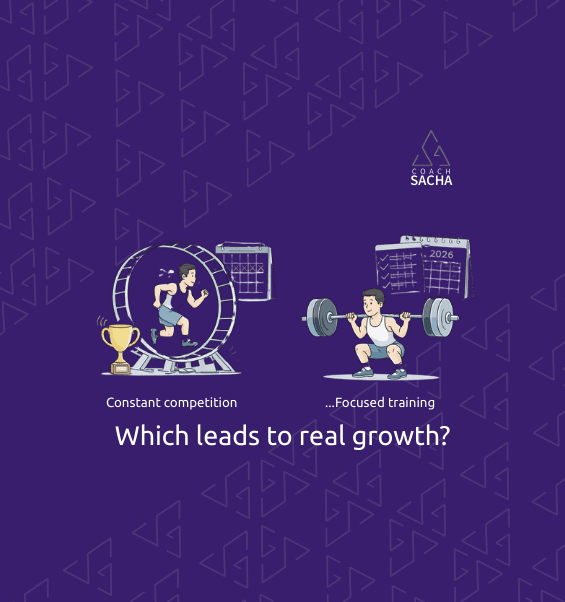
His original plan: follow the usual route, hit every competition and squeeze in upgrades between meets. My head went straight to the noise. If your skill set is behind right now, why burn months on competitions that don’t shove you forward? Sure, they quality-check your work and show you where you are, but they don’t catapult you to the next level. So why not take a sabbatical from the external scoreboard and hammer the gaps you actually need?
I raise this issue at every club I walk into. Why are we demanding seven competitions a year from 9- to 10-year-olds? (Where I’m working right now, that’s the quota.) Competitions, for me, are simply tests, they must serve your growth, not your ego. I drill the line into my athletes: “I’m going to see what they tell me I need to improve.” Too many kids never get that chance; they absorb “I must place well or I’m not enough.”
After reading Carol Dweck’s Mindset, I’m learning to push people toward goals that keep them improving instead of letting the goals define them.
So here’s the kicker: a well‑timed pause can be louder than any podium applause.
If an athlete spends a season chasing every meet, the noise can drown out the real work, fixing the weak spots that keep them from leaping to the next level. By stepping off the competition treadmill, we give the athlete space to rebuild the foundation, to experiment, to fail safely, and to come back stronger and clear‑sighted.
The goal isn’t to avoid competition forever; it’s to treat each meet as a checkpoint, not a definition of worth. When we shift the conversation from “I must win this race” to “What will this race teach me?”, the athlete learns to love the process, stays motivated during setbacks, and ultimately runs farther.
So, next time you see a young talent grinding through endless meets, ask yourself: Is this a sprint toward growth, or a marathon of noise? If the latter, consider the sabbatical. It might just be the fastest shortcut to that 2028 Olympic dream.
Training Gallery
Related Trainings