When “Specific” Becomes Dangerous
Good coaching isn’t about doing more — it’s about knowing what, when, and how much. Without understanding dosage, even good intentions can break bodies.
Date
Jan 26, 2026
Service
Overview
I worked for a while with a coach who was good at teaching gymnastics, but clearly never learned what dosify meant. Most of his gymnasts had some sort of overuse injury or growth issue. One grew so much in such a short time that his body never adapted to the new conditions.
A few had biceps tendinitis. Others had constant lower-back pain.
When I started working with him, I asked,
“Are you not doing complementary weight training to sort these problems?”
He replied that he’d start soon.
Fast-forward a couple of months. I ended up helping him in the weights room, and what I saw was… baffling. Exercises were done in ways that didn’t help the athletes — they overloaded the tissues instead.
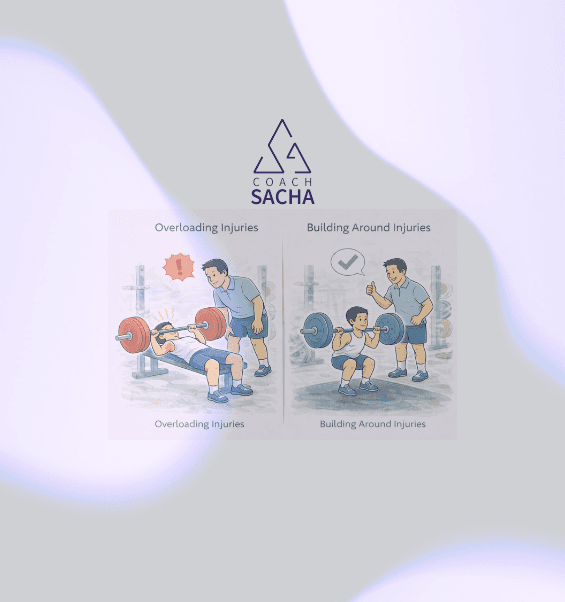
Heavy bench press for an athlete with biceps tendinitis.
Knee-dominant squats for kids already dealing with knee problems.
Me being me, I started adjusting things. Teaching better technique. Modifying exercises so we could build around the injuries and let tissues recover.
What happened next was ridiculous.
I was in the middle of changing one athlete’s squat to engage the glutes more — reducing knee load — when the coach started shouting at me. His argument was that what I was doing “didn’t relate to gymnastics,” and that the other way was more specialized.
That moment stuck with me.
How much of old-school coaching is just ignorance dressed up as certainty?
How often does ego keep people stuck instead of learning?
I was lucky during my own athletic career. I was taught early on that the weight room was a complement to my sport — not a replacement, not a shortcut. The goal wasn’t just strength. It was robustness. Capacity. Resilience.
So I’ll leave you with this:
Do you complement your sport?
Do you build your body more generally to distribute load — or are you overloading the same patterns again and again?
Understanding isn’t optional.
It’s what keeps athletes training tomorrow.
Training load — including volume, intensity, frequency, and recovery — is a key determinant of injury risk in youth athletes. Appropriate resistance training and gradual load progression improve tissue adaptation and lower overuse injury incidence. (Sources: Murray 2017; Drew & Purdam 2016; Faigenbaum 2009)
Training Gallery
Related Trainings